
Electricity is the lifeline of every business operation, but what happens when power cuts, unstable grids, or sudden peak charges start eating into your efficiency and bottom line?
That’s where the battery energy storage system in India is stepping in to change the game.
Currently, energy storage is not a luxury, but rather a necessity. With India’s industrial power demand surging and renewable sources becoming mainstream, companies need more than a power connection; they need control, consistency, and savings.
In this blog, we cover seven key advantages of battery energy storage systems for Indian businesses and why it’s time to make the switch.
What is a energy storage system in india?
A energy storage system in india (BESS) enables companies to store electricity for later. BESS collects electricity from various sources like the grid, solar, or wind. Unlike diesel generators, BESS is also cleaner and easier to deploy. It is a safety net, a power bank, and a cost manager all in one. A technical overview shows that a BESS consists of battery cells integrated with direct current (DC) and alternating current (AC) converters, battery safety protection systems and a controller that integrates the various systems to determine whether to charge, discharge, or standby. Systems range from small factory installations to large shipping container installations that provide energy to a utility grid.
How Much do Energy Storage Systems Cost in India?
The costs of battery storage systems depend on various technological, scale, and configuration factors. However, for planning, a few representative numbers can be useful.
Capital Cost:
Recent estimates for utility-scale BESS in India have been in the range of ₹2.2–2.4 crore per MWh. However, as global battery manufacturing capacity increases, costs will likely continue to fall.
Levelized Cost of Storage (LCoS):
Government cost-benchmarking for large BESS projects has been in the range of ₹5.5–6.6 per kWh of stored energy delivered.
Commercial & Industrial systems:
due to their smaller scale, can cost more on a per unit basis. However, as the C&I customers typically pay much higher peak tariffs than utilities, the payback period tends to be shorter.
What determines your quote:
chemistry (i.e. Li-ion vs LFP vs alternatives), system size, the capacity of the inverter and/or PCS, the need for indoor vs outdoor enclosures, monitoring/EMS and other software, and the complexity of the installation.
When a BESS quote is provided, the cost should not be viewed in terms of the capital cost alone, but as a means to determine the demand charge savings, energy arbitrage, or the avoidance of diesel/cost of downtime. For a mid-sized industrial facility with a properly designed system, a return on investment is generally less than 5 years assuming a favorable tariff structure.
How Do Battery Energy Storage Systems Work?
A Battery Energy Storage System (BESS) is not a single unit, but a combination of different products performing different tasks in different steps.
The first step is charging. Battery energy storage systems combine AC power to DC power by means of a power conversion unit. The AC power can be sourced from the utility grid or generated by solar or wind units.
Once charged, the battery modules convert the power to a chemical state. Battery Energy Storage System on each individual module is responsible for monitoring the active cell voltage, temperature, and charge state to maintain the safety and efficiency of the system during operation.
In the third phase, the power storage system is discharged. BESS discharge power when it is needed either during power outages, peak demand periods, or fluctuations in the input from renewable energy sources.
During the cycle, safety systems that are installed (fire safety, thermal protection systems, and protection systems) in the battery energy storage system prevent overcharge and overheating.
Types of Energy Storage Technologies Available in India
While Battery Energy Storage Systems (BESS) are the most widely utilized systems for energy storage in India, there are many others to consider. Understanding the types of energy storage systems may help you decide which would be more appropriate for your given situation.
Li-ion Batteries
For applications that need commercial and/or industrial scalability, Li-ion batteries may be the best choice. These systems offer superior energy density, fast charging cycles, and long life cycles when compared to other battery systems.
LFP Batteries
For safety and thermal stability concerns, LFP batteries may be the preferred choice. There is a small loss in energy density when compared to Li-ion batteries.
Sodium-Based Batteries
Moving away from Li-ion, sodium-based batteries use more abundant and less expensive materials than lithium. They also have lower energy density compared to Li-ion, but with less volatile and expensive materials, this makes them attractive for large-scale storage when public subsidies decrease.
Flow Batteries
With a focus more on scalability than compact size, flow batteries utilize external tanks to hold liquid electrolytes. They tend to be more utilized for large-scale grid applications where sustained energy output is important for many hours.
Pumped-Storage Hydropower
Pumped-storage hydropower is India’s largest scalable storage method, where excess energy is utilized for pumping water to an elevated storage location. When energy is needed, it is discharged by allowing the water to flow through a turbine.
Thermal Energy Storage (TES)
Some technologies, like thermal energy storage (TES), require certain geographical conditions but offer a long lifetime and high energy densities. They store heat or cold (often using molten salts or phase-change materials) and can be applied to industrial process heat and solar thermal technologies.
Compressed Air Energy Storage (CAES) and Flywheel Technology
Both mechanisms have a small energy capacity but can be quickly adjusted and are better suited for short-term fluctuations in power.
For the majority of the commercial and industrial sector in India, LFP-based and Li-ion battery energy storage systems (BESS) are the preferred options in the absence of other cost-effective alternatives, since Li-ion and LFP batteries have the advantage of mature technology with wide availability and ease of scalability — from a single site build to a multi-site deployment.
Why India Needs Energy Storage
The Indian power sector is undergoing a rapid dual transformation, adding renewables at a rapid pace and attracting a burgeoning industrial sector. Both of these changes produce the same fundamental challenge — an energy supply and demand imbalance.
All renewables, by their very nature, are intermittent sources of energy. Energy generated during the peak generation hours of the day, where there is optimal solar or wind energy, may go to waste without a way to store this energy. The remaining hours of the day and the low generation hours of the day will still have an energy demand that needs to be met with reliable sources of energy.
The grid’s reliability is more challenging for continuous businesses as they face steep time of use differentials.
Energy storage balances the supply and demand of energy by allowing continuous energy renewable energy generation. In addition, energy storage offers a business the capability to manage its operational costs, even if the conditions of the grid remain unpredictable.
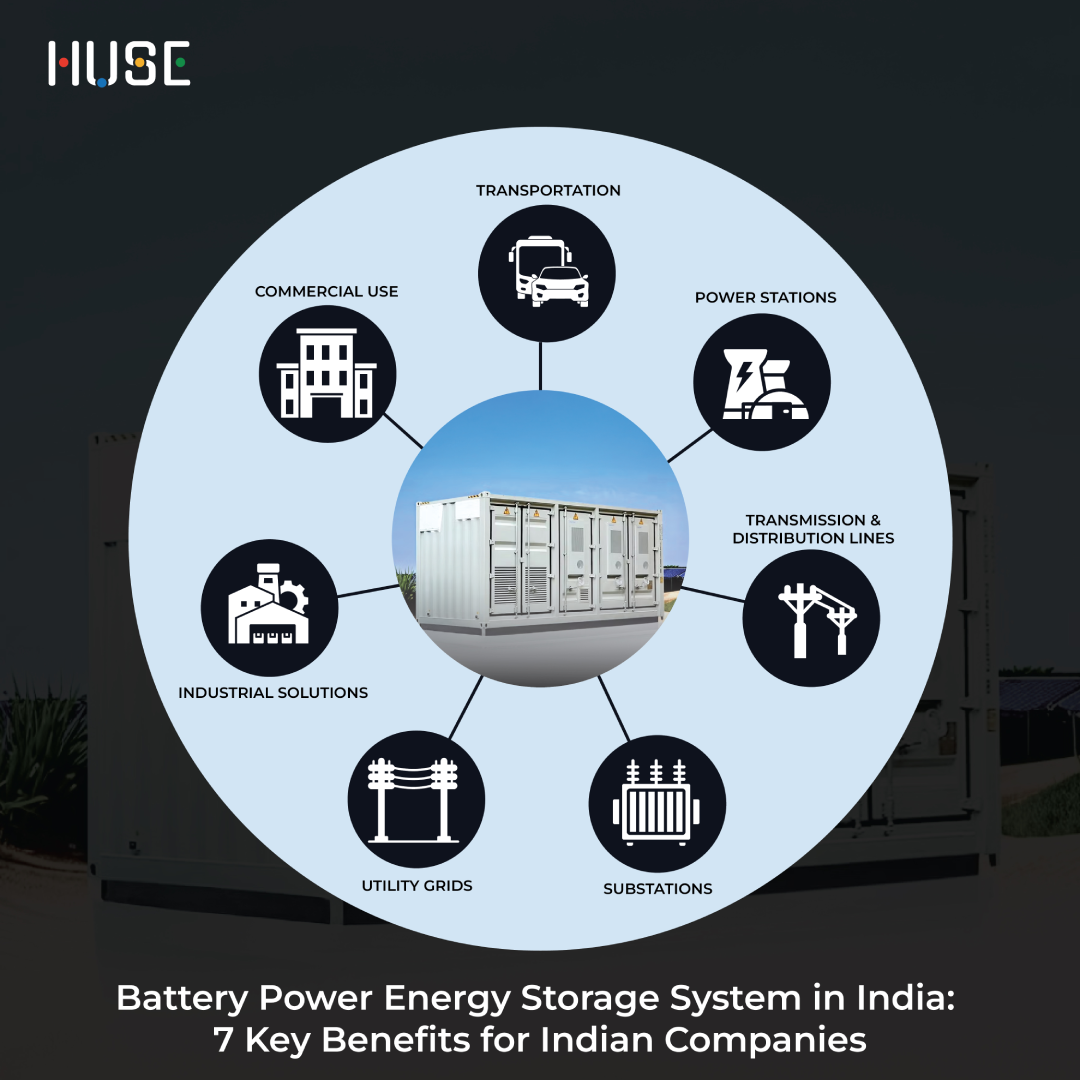
7 Key Advantages of an Energy Storage System in India for Businesses
1) A Backup that is Actually Backup
There are still many places in India that suffer from power outages. To date the diesel generator sets have been used as temporary measures, but they are costly, pollute, and are hard to maintain. A battery energy storage system provides instant backup without the rotation, smoke, or waiting. Waiting for a power generator gives time for equipment to be damaged beyond repair, money is essentially lost, and processes are left to idle for no reason.
2) Charge Your Grid, Rather Than Your Wallet
Time based power tariffs in India will hit companies hardest during peak hours, which can cost companies 2x more than typically off-peak hours. With battery energy storage systems (BESS), you can charge batteries during off-peak hours and use stored power during the peak hours, which is known as energy arbitrage. This is a particularly favorable system for companies with continuous operations and heavy machinery. The savings continue to increase over time with no changes to the operating system.
3) Use Energy that is Always Reliable
An integrated battery storage system can be a great addition to renewable energy sources, as they do not work optimally on their own due to lack of intermittent conditions. Battery storage systems can capture excess renewable energy, which can be discharged when required. This provides a less wasteful solution, and can help maintain your output levels of renewable energy.
4)Say Goodbye to Power Fluctuations
Voltage irregularities can cause sensitive equipment to fail, disrupt the production process, and even lead to an unplanned shutdown of the equipment. BESS systems eliminate production gaps, regulate power, and balance fluctuations in temperatures causing equilibrium throughout the manufacturing process. This capability benefits manufacturing facilities, hospitals, data centers, and others using high-precision equipment.
5)Scalable to Match Your Growth
Power storage systems provide the flexibility to choose between over or under investing. BESS systems allow their clients to start small and grow as their business grows. Clients do not have to replace the entire system and can continue to expand upon it.
6)Meet Your Sustainability Goals (and CSR Too)
Customers and stakeholders care about companies and their environmental impacts. By reducing your reliance on diesel and utilizing cleaner energy sources, BESS systems help clients reach their sustainability targets and also strengthen their CSR and ESG reporting.
7)Prepare for Regulatory Compliance
Regulatory burdens are increasing. energy storage system in india help their customers get ahead of the curve with regard to regulatory compliance, including tightening carbon credit requirements and improving standards of electricity quality. Also, per state laws, customers can receive incentives from state regulators for battery-backed renewable energy.
Based off of the National Electricity Plan, customers of BESS can anticipate an industry-wide requirement of large-scale deployment of energy storage system in india units.
Is a Battery Energy Storage System Safe? Fire Safety and Compliance
Battery storage brings up safety concerns at any scale for any business, and rightfully so. A well-designed BESS (Battery Energy Storage System) accounts for many safety concerns through several control layers.
Battery Energy Storage System (BMS): Defense against cell level over charge and discharge along with thermal runaway
Thermal management: System active cooling and heating defense against unsafe operation temperatures
Fire Safety: Early gas and smoke detection paired with system design that contains fire to a single module or rack
Safety components and enclosures: System design that is built to international safety standards for stationary battery storage
A BESS vendor’s BMS, thermal management, and fire safety designs, along with certifications, should be the area of greatest focus when evaluating a specific vendor. A safe BESS should be fully passive, and any safety design should not create an ‘operational burden’ on the owner. Safety should be built into the system itself vs an employee or contractor ‘managing’ the system.
Government Policies and Incentives for BESS in India
Speed and understandability of policy is essential in a developing market and India is quickly aligning its policies for battery siting.
National Electricity Plan (NEP) 2023-
The NEP, published by the Central Electricity Authority, forecasts a steep increase in India’s battery storage requirement with a new focus on large-scale BESS deployment.
Viability Gap Funding (VGF) Scheme –
The VGF, also published in 2023, endeavors to cover a majority of the capital cost of battery storage deployment and sets up a phased government contribution funding scheme to support the deployment of several thousand megawatt-hour battery storage by the early 2030s.
Energy Storage Obligation (ESO) –
The ESO, published by the Ministry of Power, mandates a procurement of an increasing percentage of renewable energy sources to include energy storage, thus creating a demand for energy storage deployment.
Electricity (Amendment) Rules –
Formal recognition of energy storage systems as part of the power system will allow their deployment to be regulated as generation, transmission, or distribution assets.
ISTS charge waivers –
Inter-State Transmission System (ISTS) charges have been eliminated for qualifying BESS projects, creating a reduced cost for the interstate transport of stored electricity.
DG set replacement rules —
Customers who rely on diesel generators for backup power are being given time frames by state commissions to switch to less harmful options like renewable energy paired with storage.
This means early investments by companies in BESS technology will be encouraged by Indian policy through a combination of government funding and easier access laws, as well as additional responsibilities for renewable generators.
This is in contrast with the current situation which is largely apathetic toward such steps.
Consumers relying on diesel generators as backup power are being pushed toward cleaner alternatives, including renewable-plus-storage combinations, within defined timelines set by state commissions.
For businesses, the practical takeaway is that Indian policy is actively rewarding early
BESS adoption —
through funding support, regulatory clarity, and rising obligations on renewable generators — rather than simply tolerating it.