

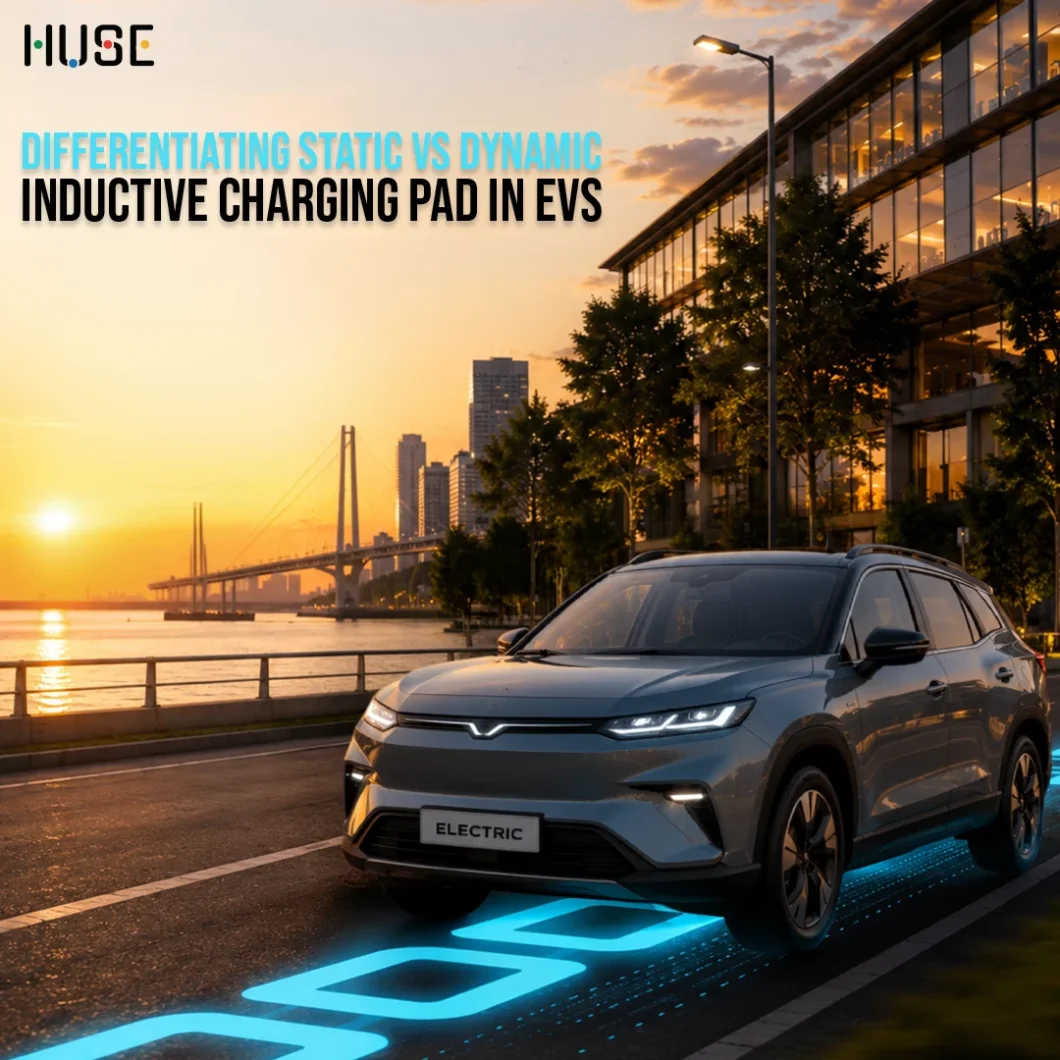
What Is an Inductive Charging Pad?
An inductive charging pad is a ground-based or under-vehicle unit that transfers electricity to an EV battery without any physical plug or cable. It relies on electromagnetic induction, the same basic idea used in wireless phone chargers, just scaled up for higher power. Once a vehicle parks correctly over the pad, charging usually starts on its own within seconds. This makes inductive charging EV systems genuinely useful for busy depots and home garages where plugging in daily gets tiring for you.How Does Inductive Charging Work?
To understand how does inductive charging work, it helps to look at the process in four simple steps.- It starts with a pad fixed into the ground and wired to the power supply. There is a transmitter coil inside the pad, and once the power begins flowing into the coil, the coil creates an alternating magnetic field surrounding it.
- The EV carries its own half of the system, a receiver coil tucked under the vehicle’s floor. When the car parks correctly, this coil lands right inside the reach of that magnetic field waiting below.
- At this point, the laws of physics start working. Since the magnetic field is constantly changing, it generates current in the receiver coil. It is a process of electromagnetic induction in real-life practice.
- Electronic devices in the vehicle transform and stabilize the current, after which it is sent directly to the battery.
Static vs Dynamic Wireless Charging: Fleet Wireless Charging Solutions Explained
Most operators looking into fleet wireless charging solutions end up choosing between two very different setups. One works with a parked vehicle, and the other works while the vehicle keeps moving on the road.Static Wireless Charging
Static charging is the simpler option, and it is also the one most ready for commercial use today. The vehicle parks directly over a pad, and the session runs almost like a wired charge, just without the cable. Homes, fleet depots, public parking bays, and two-wheeler charging points all use this model comfortably. According to Mordor Intelligence’s 2025 wireless EV charging market report, static pad systems already hold 81.32% market share, reflecting simpler installation and proven reliability over dynamic setups. That single number says a lot about where the near-term opportunity for an inductive charging pad truly sits.Dynamic Wireless Charging: Fleet Wireless Charging Solutions in Motion
Dynamic charging embeds a series of coils along a stretch of road, allowing an EV to top up its battery while driving. It’s a far more ambitious application, still largely at the pilot stage globally. However, it holds real promise for fleet wireless charging solutions built around buses, delivery trucks, and taxis running fixed, high-mileage routes. The same market research notes that momentum in this space is accelerating, with the global wireless EV charging market projected to grow from roughly USD 84.23 million in 2025 to USD 789.26 million by 2031. This shows a 45.2% CAGR, driven partly by the release of the SAE J2954 wireless charging standard.Key Difference Between Static and Dynamic Charging
| Aspect | Static Charging | Dynamic Charging |
|---|---|---|
|
Vehicle state |
Parked |
Moving |
|
Infrastructure |
Single charging pad |
Coils embedded along a route |
|
Best suited for |
Homes, depots, parking bays, 2/3-wheelers |
Highways, bus corridors, high-mileage fleets |
|
Deployment stage |
Commercially available |
Largely pilot stage |
|
Efficiency |
Higher (fixed alignment) |
Variable (depends on speed) |
Why Choose Huse for Purchasing Inductive Charging Pad in EVs
As battery technology matures and coil efficiency improves, the inductive charging pad is on track to become a standard fixture in fleet depots, residential complexes, and public infrastructure. Choosing the right wireless charging partner now, while static systems are commercially mature and dynamic systems are advancing, puts fleet operators ahead of a fast-moving infrastructure shift.
This is where HUSE HQ comes into the picture for fleet operators across India. We build these pads for real Indian roads, real heat, and the daily grind of fleet use, not just lab conditions. Our goal is simple: less downtime, less wear on connectors, and a charging setup that works for anything from e-scooters to full commercial fleets.
If you run a fleet and want to see this in action, get in touch with Huse HQ.
FAQ's on Inductive Charging Pad
What is the use of an inductive charging pad in an electric vehicle?
The inductive charging pad offers wireless battery charging for an EV without the need for any plug or wires throughout the process. The inductive charging process transfers energy from a ground coil to a receiver coil installed under the car.
What is the difference between inductive charging and regular electric vehicle charging?
While conventional charging involves a wire, inductive charging takes place via the magnetic field that passes between two coils. The magnetic field induces a current that is further converted to electrical power by the electronics in the vehicle.
Is inductive charging for electric vehicles operational in India currently?
Yes, static inductive charging systems for electric vehicles are in use for the most part in two- and three-wheelers as well as fleet depots. Road-based dynamic systems are still at the development stage in most countries..
What distinguishes the fleet wireless charging systems from Huse HQ?
The fleet wireless charging system offered by HUSE HQ is built considering Indian conditions, including the monsoons and frequent use of the vehicle fleet. Reliability is one of the key aspects of such a system