

If you’ve ever looked at a high-performance tyre, a hydraulic seal, or even the vibration mount under a heavy industrial motor, you weren’t just looking at “rubber.” You were looking at the results of years in engineering and a very specific chemical formula. In the manufacturing world, raw rubber is almost useless on its own. It’s too soft when warm, too brittle when cold, and it would melt or dissolve the moment it touched oil or high heat.
That is where compounding comes in. For any rubber compound supplier, the job isn’t just about selling material; it’s about solving a problem. At Huse HQ, we see this every day, whether a client needs a seal that won’t fail in a 200°C engine or a gasket that can survive a decade in corrosive seawater.
What exactly is Compounded Rubber? Insights from a Leading Rubber Compound Supplier
Think of compounded rubber as a reinforced version of nature. It is a precisely engineered blend where raw elastomers (the base) are mixed with a cocktail of chemicals and fillers to achieve a specific set of physical properties.
While raw rubber is the foundation, it’s the rubber compound manufacturers in India who give that foundation its “personality.” A compound can be as hard as a hockey puck or as stretchy as a rubber band, all by adjusting the formula.
The Technical Breakdown: What’s Inside? Explained by a Leading Rubber Compound Supplier
Rubber compounding is the process of creating a specific “recipe” of elastomers and additives to meet a set of performance goals. You aren’t just using raw rubber; you are modifying it to survive heat, oil, or extreme pressure.
The Base Polymer (Elastomer):
This is the foundation. It could be natural rubber or a synthetic type like EPDM or Nitrile (NBR). The polymer decides the personality of the rubber, whether its flexibility, reaction towards chemicals, or handling temperature.
Plasticisers and Softeners:
These don’t stay for appearance. With the help of the plasticisers and softeners, the rubber becomes workable during manufacturing. Without them, it’s very difficult to shape and mold the rubber.
Antidegradants:
Antidegradants are basically protective additives. Antioxidants and antiozonants are used to stop the rubber from cracking when exposed to sunlight, oxygen, or heat.
The Curing System:
This includes vulcanising agents (like Sulfur) and accelerators. This is the most critical part, it’s the chemical “engine” that turns a soft, gummy mass into a stable, elastic solid.
The Most Common Types You’ll Encounter: A Guide from a Rubber Compound Supplier
Choosing the right base material is the most expensive and important decision a rubber compound supplier will help you make. Here are the heavy hitters:
- Nitrile (NBR): The go-to for anything involving oil, fuel, or grease. You’ll find this in every engine bay in the country.
- EPDM: The king of the outdoors. It doesn’t care about UV rays or ozone. It’s the standard for roofing, window seals, and automotive weatherstripping.
- Natural Rubber (NR): Still unmatched for pure mechanical “toughness” and vibration damping. This is why heavy-duty engine mounts and giant truck tires still rely on it.
- Silicone: When the temperature goes above 200°C or drops below -50°C, silicone is usually the only thing left standing. It’s also chemically inert, making it the choice for medical and food-grade parts.
- SBR: A general-purpose workhorse. It’s cheaper than natural rubber and offers great abrasion resistance, which is why it dominates the conveyor belt and tire markets.
Functioning: How It Actually Works Under Pressure According to a Trusted Rubber Compound Supplier
The “function” of a compound is its ability to return to its original shape after being crushed, stretched, or heated. This is called Compression Set.
In an industrial pump, a seal is constantly being squeezed. A poor-quality compound will “take a set”, meaning it stays flat and stops sealing. A high-quality compound from a reputable manufacturer is engineered to “fight back,” maintaining its seal even after years of constant pressure. At Huse HQ, we test our compounds specifically for this “rebound” because, in the real world, a 1% failure in a seal can lead to a 100% failure in a machine.
From Formula to Product: Techniques Used by a Trusted Rubber Compound Supplier
Creating the compound is only half the battle. Getting it into a usable shape requires serious machinery.
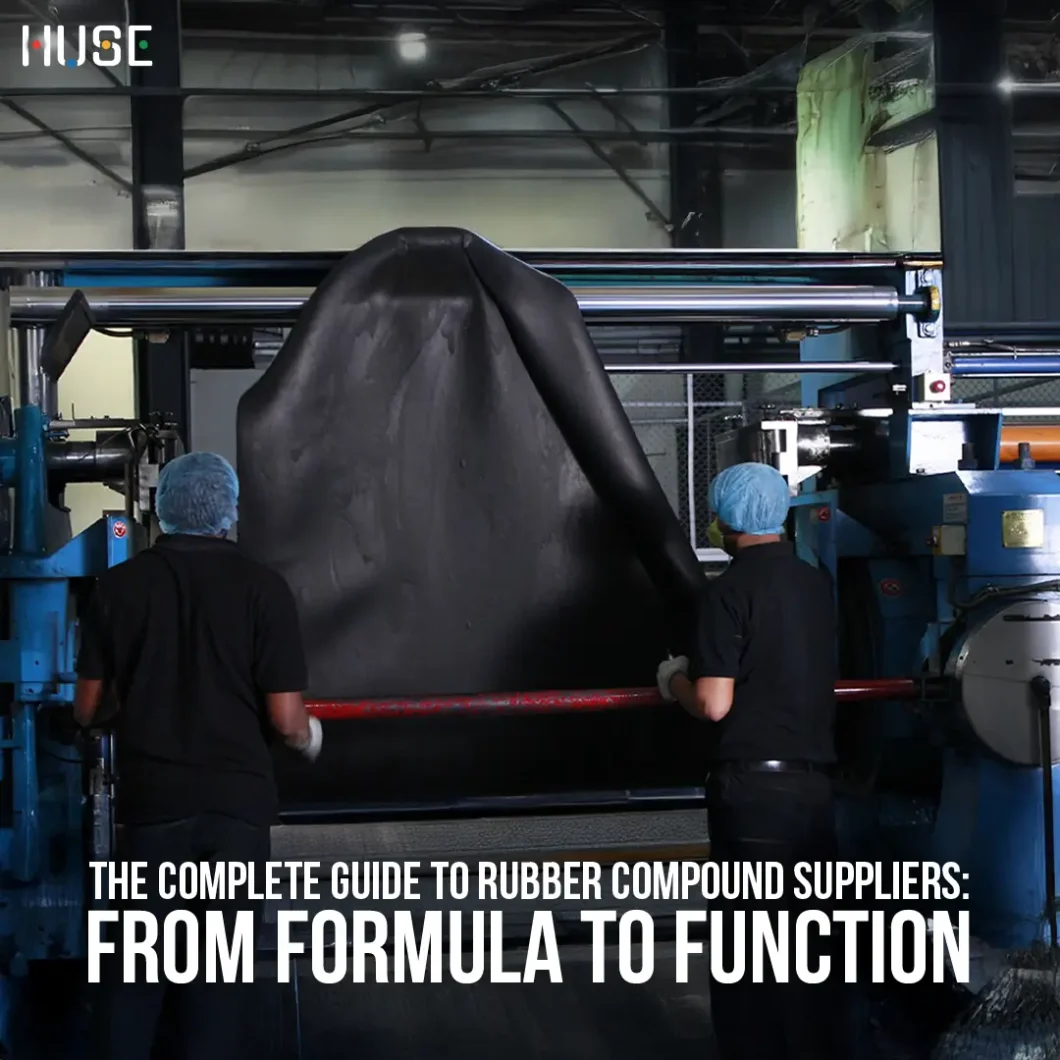
- Internal Mixing: This is where the magic starts. Large “Banbury” mixers use massive rotors to shear the rubber and force the fillers and chemicals into a uniform mass. It generates a lot of heat, which must be carefully managed to prevent the rubber from “scorching” (curing too early).
- Extrusion: If you need a long, continuous profile like a window seal or a hose, the compound is forced through a shaped die. It’s like squeezing toothpaste through a star-shaped nozzle, but with several tons of pressure.
- Molding (Compression & Injection): For precise parts like O-rings or engine mounts, the compound is placed into a heated metal mold.
Injection molding is the fastest and most precise, used for high-volume parts.
Compression molding is better for thicker, heavier parts where the rubber needs time to flow. - Vulcanisation (Curing): This is the final stage. The shaped part is kept under heat and pressure. The chemical cross-links form, and the material is permanently “set.” Once a part is vulcanised, it cannot be melted back down; it is now a thermoset material.
Why the Choice of Rubber Compound Supplier Matters?
You might find ten different rubber compound manufacturers in India offering the “same” Nitrile compound, but the results in the field will tell a different story.
Compounding is a game of precision. If a manufacturer skimps on the Carbon Black or uses a cheaper plasticiser, the part might look identical when it leaves the factory. But six months later, under the hood of a car or at the bottom of an oil well, that part will crack, swell, or disintegrate.
A reliable rubber compound supplier doesn’t just provide a material; they provide consistency. They ensure that Batch #1 and Batch #100 have the same Shore Hardness, Tensile Strength, and Elongation properties.
Conclusion
At Huse HQ, we believe that compounded rubber is the silent hero of the modern world. It’s the material that handles the friction, the heat, and the pressure so that the rest of the machine doesn’t have to. Are you struggling with a part that keeps failing in the field? It’s likely a compounding issue. Let’s talk about your specific application. At Huse HQ, we don’t just sell rubber; we engineer solutions that stay the course. Reach out to our technical team today!